Honey Bee Parasites, Pests, Predators & Diseases
Index

Introduction

I. Normal Honey Bee Development

A queen honey bee

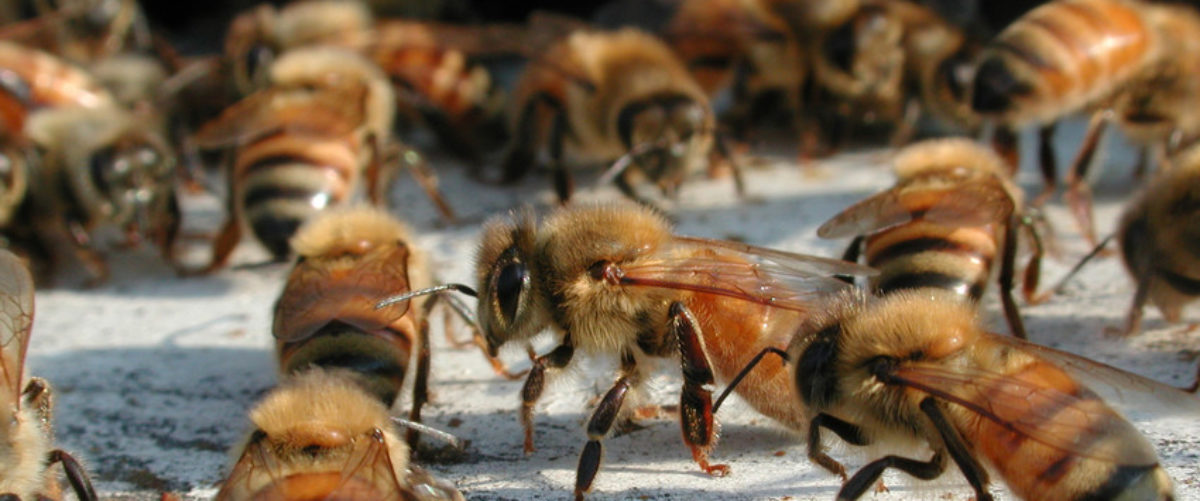
A worker honey bee

A drone honey bee

Healthy honey bee eggs

Healthy c-shaped larvae

Capped brood

Developing pupae

Emerging adult worker bee

II. Honey Bee Parasites

Varroa Mite (Varroa jacobsoni)

Adult female Varroa mite

Scanning electron micrograph (SEM) of Varroa mite between abdominal segment

Diagram of Varroa mite life cycle

Different life stages of Varroa mite feeding on a drone bee (just before emerging)

Emerging worker bee with Varroa mites

Varroa damaged worker bee

Varroa mite on drone pupa

Malformed workers on comb

Taking an ether-roll sample

Adding ether-based aerosal to jar

Varroa mites sticking to jar

Drone pupae removed with uncapping fork

Preparing colonies to be moved for pollination

Apistan® strips in a colony

Parasitic Mite Syndrome (PMS)

Virus infected larvae

Apistan

Terramycin®

Fumidil-B®

Honey Bee Tracheal Mite (Acarapis woodi)

Diagram of male and female tracheal mite

Diagram of tracheal mite life cycle

Scanning electron micrograph (SEM) of tracheal mite just inside of a trachea

Healthy and infested tracheae

Severely infested trachea

Winter cluster with reduced population

Menthol packet

Menthol Map

Menthol placement on colony

Grease Patties

III Pests of Honey Bees

Bee Louse (Braula coeca)

Bee louse

Bee louse tunnels in honey cappings

Braula on queen

Wax Moth (Galleria melonella), larval wax moths on damaged combs

Adult wax moths

Damaged combs showing silken galleries

Cocoons attached to frames

Strong colonies

PDB crystals in use to protect stored equipment

Mice

Mice Damage to combs

Hardware cloth fitted to hive entrance

Ant nest between the inner and outer cover

Colonies raised off the ground

IV. Predators of Honey Bees

Small hive beetle
(adult and larva)

Small hive beetle larvae (masses) on a hive bottom board

Adult beetles on comb

Skunks

Indications of skunk feeding at hive entrance

Skunk feces with honey bee exoskeletons

Hives elevated off ground

Bear damage to apiary

Apiary location near forest edge

Bear damage

Bear fence

V. Diseases of Honey Bees
American foulbrood
(AFB Text)

AFB: Punctured, sunken cappings

American foulbrood (Drawing: dead melted-down larvae)

American foulbrood
(scale)

American foulbrood
(pupal tounge)

American foulbrood (irregular brood pattern)

American foulbrood
(testing for AFB)

American foulbrood
(hive inspection)

American foulbrood
(burning hives)

American foulbrood (Terramycin® antibotic)

American foulbrood (application of Terramycin®)

European Foulbrood
(EFB - Text)

EFB
(young diseased brood in open cells)

EFB
(drawing: blochy and twisted brood)

EFB
(Terramycin® application)

Chalkbrood
(Text)

Chalkbrood
(chalkbrood mummies)

Chalkbrood
(chalkbrood in cells)

Chalkbrood
(chalkbrood at hive entrance)

Sacbrood
(Text)

Sacbrood
(sealed cells with punctures and affected larvae)

Sacbrood
(prepupae in sack)

Parasitic mite syndrome (PMS Text)

Parasitic mite syndrome (Virus infected larvae)

Parasitic mite syndrome (Apistan® treatment)

Chilled Brood
(Text)

Nosema
(Text)

Nosema
(fecal staining on the outside of the hive)

Nosema
(dysentery text)

Nosema
(comparasion of healthy and diseased honey bee gut)

Nosema
(nosema spores)

Nosema
(Fumidil® - B box)

Paralysis
(Text)

Paralysis
(greasy, hairless bees)


© The Pennsylvania State University 2002
This publication is available in alternative media on request.
Penn State is committed to affirmative action, equal opportunity, and the diversity of its workforce.

Questions or comments should be emailed to Roxie Smith at roxiesmith@psu.edu
Last modified, 5/12/2003