Pollination | Beekeeping Information Index
Mid-Atlantic Apiculture
Farmers can provide the best agronomic practices-proper seedbed
preparation, fertilization, Soil moisture, cultivation, pest control,
and harvesting methods-and fail to obtain a bountiful harvest,
if they neglect to provide for pollination. Many of their fruit
crops, legumes, vegetables, and oilseed crops depend upon pollinating
insects for set of fruit or seeds. Therein lies the basis for
the most important contribution made by any insect to agriculture-pollination
by the honey bee.
Flowering and Fruiting in Plants
Some knowledge of the flower structure and fruit setting is necessary
to understand the entire pollination process. All flowers have
the same basic pattern, but there are many variations. The peach
blossom, the tassel and ear of corn, and the sunflower head appear
remarkably different, but all have the same basic parts.
Typically, the flower is composed of the sexual organs, protected
by the usually colorful delicate petals that may form a sort of
tube or crownlike corolla. These are supported and partially protected
by the usually green and more durable sepals, collectively called
the calyx. The calyx and corolla combined are referred to as the
perianth. There may be leaflike bracts just below the sepals.
The male parts of the sexual organs are the stamens and there
may be one to several dozen in a flower. The stamens usually consist
of hairlike filaments bearing the pollen-producing anthers on
the outer ends. At the appropriate time, the anthers dehisce or
split open and disgorge the male element, the numerous microscopic
and usually yellow grains of pollen.
The female part of the flower is the pistil, consisting of the
ovary, with one to numerous ovules or potential seeds, and extending
from the ovary is the style, with the pollen-receptive portion,
the stigma, on or near the tip. The pistil may be composed of
one or more carpels or sections. Typically, the ovary, with its
style and stigma, surrounded by the stamens, occupies the central
area of the flower. Nectar usually is secreted at the base of
the pistil, inside the corolla. Nectaries also may occur outside
the corolla. These usually are referred to as extrafloral nectaries
and do not contribute to pollination.
The ovules produce the seeds, and the ovary develops into the
fruit. Usually one ovule must be fertilized for each seed that
develops. if no seeds are produced, the fruit is unlikely to develop
although a few fruits (certain cucumbers and citrus varieties)
develop parthenocarpically (without being pollinated). if an insufficient
number of seeds develop, the fruit is likely to be asymmetrical
or otherwise not fully developed.
In general, the sooner pollination can occur after a flower opens,
the greater the likelihood that fertilization of the ovules and
seed development will occur. As time elapses, the pollen may be
lost to insect foragers, wind, gravity, damage by heat, moisture,
or drying out. Also, processes may set in that result in the shedding
of the fruit.
Pollination and Fertilization
Usually, we think of pollination in the combined sense of transfer
of pollen and set of fruit or seed. Actually, two sets of factors
are involved: (1) transfer of viable pollen from the anther to
a receptive stigma, and (2) sprouting of the pollen grain and
growth of the pollen tube down the style into the ovary, and ultimately
the union of male nuclei of the pollen grain with female germ
cells in the ovule that results in seed development. Pollination
is of no value without fertilization.
Sterility, Fertility, and Compatibility
Most flowers have both male and female functional parts. Some
plants, however, such as asparagus, coriander, dill, or squash
may have only male flowers, in which the ovaries are nonfunctional,
or female flowers, in which the anthers are nonfunctional. In
others, the stigma may not be receptive when the pollen is available
within the flower. In such flowers, the pollen must be transferred
from the male flower to the female. If the flower has both functional
parts and is receptive to its own pollen, it is said to be self-fertile.
If the flower is not fertilized by its own pollen, but is fertilized
only when pollen comes from another plant or variety it is referred
to as self-sterile. For example, both the 'Red Delicious' and
'Golden Delicious' apple are largely self-sterile, but when interplanted
and cross-pollinated each will fertilize the other and good production
of fruit is obtained. They are cross-compatible. Varieties that
will not cross-fertilize are said to be cross-incompatible.
A plant may be self-fertile but not self-pollinating. A pollinating
agent may be necessary to transfer the pollen from the anthers
to the stigma.
The avocado flower is an unusual example of the need for cross-pollination
by bees. It opens twice on subsequent days. The first day the
stigma is receptive to pollen but none is released by the anthers.
After a few hours, the flower closes. The next day, it opens again
when the stigma is no longer receptive to pollen, but the anthers
release sticky clumps of pollen. Again the flower soon closes,
never to reopen; therefore, it cannot be self-pollinated.
Still more unusual is the characteristic of some varieties of
avocado flowers to open for the first time in the morning of the
first day and in the afternoon of the second day. In other varieties,
the flowers open in the afternoon of the first day and in the
morning of the following day. Only when growers interplant two
such varieties, where pollen is always available when stigmas
are receptive, and they provide bees to serve as the cross-pollinating
agents, are they capable of harvesting the maximum set of fruit.
In addition to the volume of the crop produced through adequate
pollination, another value lies in the effect of pollination on
quality and efficiency of crop production. Inadequate pollination
can result in reduced yields, delayed yield, and a high percentage
of culls or inferior fruits. With ample pollination, growers may
be able to set their blooms before frost can damage them, set
their crop before insects attack, and harvest ahead of inclement
weather. Earliness of set is an often overlooked but important
phase in the crop economy.
Hybrid Vigor and Bee Pollination
The value of pollination on the succeeding generation of crops
also is frequently over looked, The value of hybrid seed in not
reflected until the next generation. Vigor of sprouting and emerging
from the soil often is a vital factor in the plant's ear]y survival.
Other responses to hybrid vigor include earliness of development,
plant Health, and greater and more uniform production of fruit
or seed.
When two unlike varieties are cross-bred, the offspring frequently
is more robust in some characteristic than either parent. This
strengthening effect is referred to as hybrid vigor (heterosis).
Years ago, scientists learned that the offspring of two inbred
lines of corn was more productive than either parent. Then they
learned that when this offspring was crossed with another such
offspring of two other inbred lines, ever greater production was
obtained. As an example, the offspring of variety A crossed with
variety B, or A x B, crossed with C x D, is known as a 4-way cross.
Presently, most of the corn produced in the United States is derived
in this way, and is generally referred to as hybrid corn.
Corn is wind-pollinated; therefore, breeders plant certain rows
of variety A between rows of variety B. Then, by removing the
pollen-producing tassels of one variety, production of seed can
only result from pollen carried by wind from the tassels of the
other. This system works well on corn because the tassels can
be deftly removed before pollen is released.
In most of our other crops, the male and female parts are in the
same, usually small, flower. In some crops, however, breeders
have developed methods of producing and maintaining male-sterile
lines-selections that produce no pollen. Then alternate rows,
or groups of rows, are planted to normal lines and others to male-sterile
lines and all the fruit or seed obtained from the male-sterile
line is hybrid. The hybrid may be superior to the parents in productiveness,
uniformity, earliness, resistance to diseases or insects, or other
factors.
Growers currently are producing hybrid onions, carrots, cucumbers,
sunflowers, and several other crops. Research is under way on
the production of hybrid cotton, soybeans, and alfalfa. All of
these are insect-pollinated crops and will need to use colonies
of bees or other pollinating insects in their production.
Pollinating Agents
Although this handbook principally concerns honey bees and beekeeping,
pollinating agents other than honey bees should be mentioned and
their relative value considered.
Wind probably is the most important pollinating agent, insofar
as it benefits our existence. Most of the forest trees, practically
all the grasses and grains, with the exception of some that are
completely self-pollinated, and many weeds are wind- pollinated.
The flowers of most wind-pollinated plants are either male or
female. The male flowers produce an abundance of pollen to be
carried by the wind. The female flowers usually have large stigmatic
areas to receive the pollen. Corn is a good example of a wind-pollinated
crop.
Birds of several different species feed upon nectar, pollen, or
insects in some flowers and serve as pollinators. None is of significance
in pollinating our cultivated crops. Their visits are confined
largely to deep-throated, usually showy wild flowers.
Insects of many species visit flowers and pollinate them. These
include bees, wasps, moths, butterflies, beetles, thrips, and
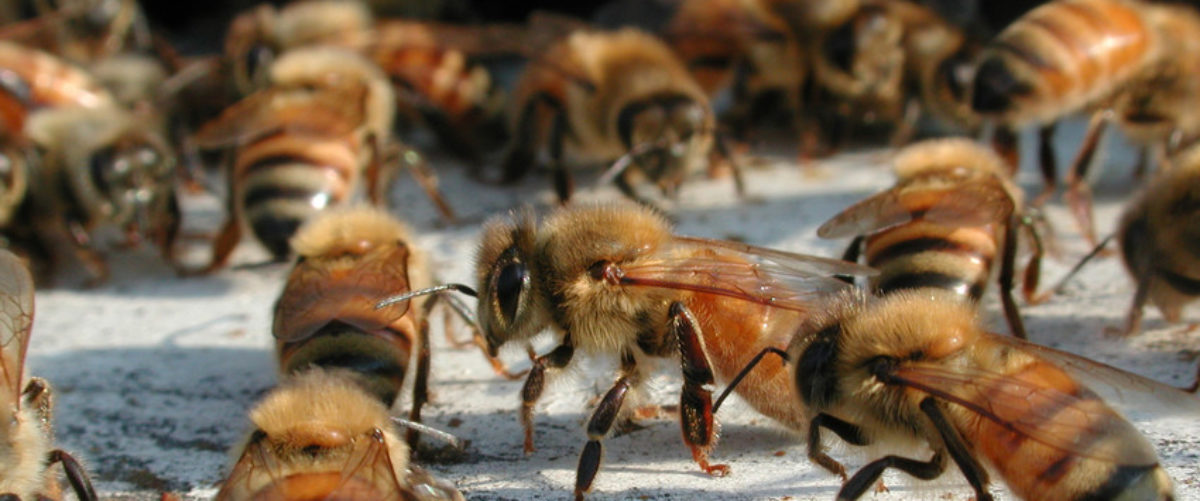
midges. Bees are the most efficient and the only dependable pollinators,
because they visit flowers methodically to collect nectar and
pollen and do not destroy the flower or the plant in the process.
Various species of bees, including the managed wild bees (see
section on Management of Wild Bees), are highly efficient. An
estimated 80 percent of our insect pollination is done by bees.
Honey Bees and Pollination
Modern agriculture has come to depend greatly upon honey bees
to fulfill its pollination needs. This insect has several valuable
qualifications for this role. Beekeepers maintain honey bees at
a high population level in most agricultural areas of the United
States for the honey and wax they produce. The colonies easily
can be concentrated when and where needed to satisfy pollination
requirements, and by using techniques developed for honey production
their numbers can be increased in a relatively short time. The
honey bee is adapted to many climates and can successfully revert
to its original wild state in most parts of the world, quickly
becoming part of the natural reservoir of pollinators.
Beekeeping in Relation to Pollination
When growers conclude that their crops must be insect-pollinated
but do not have sufficient pollinators to do the job, they may
decide to rent colonies of honey bees from a beekeeper. There
may be a local contractor with whom growers can deal-one who acts
as contact agent on behalf of a few neighboring beekeepers. Most
of the bee rentals, however, are personal arrangements between
growers and local beekeepers. Unfortunately, growers and beekeepers
consider the rental arrangement from entirely different points
of view.
Growers may consider only the fees they are paying and the potential
value of the bees to their crops, along with having the beekeeper,
the beekeeper's vehicles and crew, and the bees on their premises.
Growers want to buy a service, pay for it, then go about their
other duties.
Beekeepers consider the value of the bees to themselves before,
during, and after the pollination contract is concluded. They
weigh the advantage of the rental fee against the possibility
of a reduced honey crop and the possibility of better forage than
in their permanent location. (Beekeepers are always looking for
better locations.) They also consider the constantly threatening
adverse effect of pesticides, and the danger of damage to the
bees and equipment in making the move. The bees usually are moved
at night, and this is hard work with many chances for accidents
on the roads or in the fields. When the colonies are moved from
a location, another beekeeper may take it over. Exposure to bee
diseases increases when colonies, particularly from many beekeepers,
are concentrated in one area. And finally, problems associated
with collecting the fee after the service is rendered frequently
develop. These disadvantages discourage many beekeepers from renting
bees to growers.
Crops Dependent Upon or Benefited by Insect Pollination
The following crops are dependent upon or benefited by insect
pollination. Unfortunately, the information on their pollination
needs is scanty or based upon earlier popular varieties.
For some, insect dependence is absolute; for others, the benefit
ranges from scant to great. For most of them, there is a great
need for study of current varieties under different environmental
conditions to determine the precise dependency on insect pollinators.
|
Crops |
|
|
|
|
| Acerola | Artichoke 1 | Alfalfa | Cotton | Buckwheat 1 |
| Almond | Asparagus 1 | Alsike clover | Flax | Cacao |
| Apple | Balsam pear | Arrowleaf clover | Peanut | Cashew |
| Apricot | Broccoli 1 | Ball Clover | Rape | Chicory 1 |
| Blackberry | Brussels sprouts1 | Berseem clover | Soybean | Clove |
| Blueberry | Cabbage 1 | Black medic | Safflower | Coffee |
| Chestnut | Cantaloupe | Broadbean | Sunflower | Kola |
| Chinese Gooseberry |
Cardoon 1 | Cicer milkvetch | Tung | Lupines 1 |
| Coconut | Carrot 1 | Crimson clover | Tea | |
| Crabapple | Casaba melon | Crownvetch | Many garden flowers 1 |
|
| Currant | Cauliflower 1 | Kenaf | ||
| Feijoa | Celeriac 1 | Kidneyvetch | ||
| Gooseberry | Celery 1 | Kudzu | ||
| Grape(some kinds) | Chayote | Lespedeza | ||
| Grapefruit | Chervil 1 | Mung bean | ||
| Guava | Chive 1 | Persian clover | ||
| Jujube | Coriander 1 | Pigeon pea | ||
| Lemon | Cowpea | Red clover | ||
| Litchi | Crenshaw | Rose clover | ||
| Loquat | Cucumber | Sainfoin | ||
| Macadamia | Dill 1 | Scarlet runner bean | ||
| Maney sapote | Eggplant | Strawberry clover | ||
| Mango | Endive 1 | Sweetclover | ||
| Nectarine | Fennel 1 | Sweetvetch | ||
| Olive | Honeydew | Trefoil | ||
| Orange(some kinds) | Kale 1 | Vetch | ||
| Papaw | Leek 1 | White clover | ||
| Papaya | Lima bean | Zigzag clover | ||
| Passion fruit | Muskmelon | |||
| Peach | Mustard 1 | |||
| Pear | Onion 1 | |||
| Persimmon | Parasley 1 | |||
| Pomergrante | Parsnip 1 | |||
| Plum | Pepper | |||
| Prun | Persian melon | |||
| Quince | Pimento | |||
| Raspberry | Pumpkin | |||
| Tangelo | Radish 1 | |||
| Tangerine | Rutabaga 1 | |||
| Temple orange | Squash | |||
| Turnip 1 | ||||
| Vegetable sponge | ||||
| Welsh onion 1 |
Top of page
Pollination | Beekeeping Information Index
Mid-Atlantic Apiculture