Honey Bee Biology | Beekeeping Information Index
Mid-Atlantic Apiculture
Queen
Drones
Workers
Brood
Bee Development
![]() |
Figure 1. Three types of honey bees normally found in a honey bee colony: worker, queen, and drone. (Courtesy of the U.S. Department of Agriculture.) |
![]() |
Figure 2. Emergency or supersedure queen cells and a queen cup built on the Queen surface. |
Top of page
Drones
Drones (male bees) are the largest bees in the colony. They are
generally present only during late spring and summer. The drone's
head is much larger than that of either the queen or worker, and
its compound eyes meet at the top of its head. Drones have no
stinger, pollen baskets, or wax glands. Their main function is
to fertilize the virgin queen during her mating flight. Only a
small percentage of drones fulful this function. Drones become
sexually mature about twelve days after emerging and die instantly
upon mating. They perform no useful work for the hive. However,
the presence of a few drones is believed to improve the general
morale of the colony during the honey flow.
While drones normally rely on workers for food, they can feed
themselves within the hive after they are four days old. Since
drones eat three times as much food as workers, an excessive number
of drones certainly places an added stress on the colony's food
supply. Drones stay in the hive until about eight days old, then
begin to take orientation flights. Flight from the hive normally
occurs between noon and 4:00 p.m. Drones have never been observed
taking food from flowers.
When cold weather begins in the fall and the honey flow stops,
drones usually are forced out into the cold and left to starve.
Queenless colonies, however, allow them to stay in the hive indefinitely.
Top of page
Workers
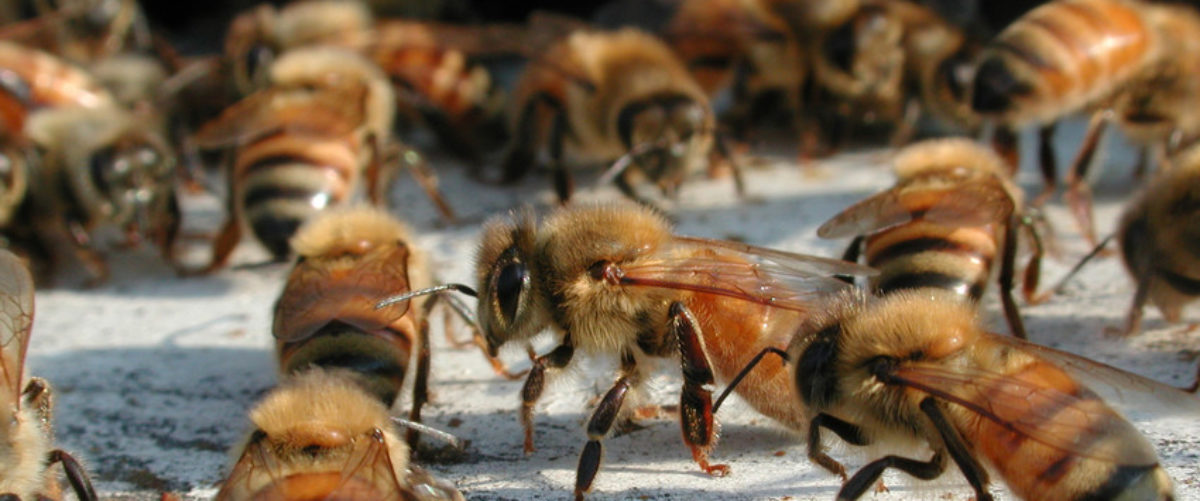
Workers are the smallest and most numerous bees in the colony.
They are sexually undeveloped females and under normal hive conditions
do not lay eggs. Workers have specialized structures, such as
brood food glands, scent glands, wax glands, and pollen baskets,
which allow them to perform all the labors of the hive. They clean
out the cells, feed the brood, care for the queen, remove debris,
handle incorning nectar, build combs, guard the entrance, and
air condition and ventilate the hive before going into the field.
In the field, they forage for nectar, pollen, water, and propolis
(plant sap).
The life span of the worker durmg summer is about six weeks. Those
reared in the fall may live as long as six months, allowing new
generations to develop early in the spring before they die.
Laying Workers. The presence of laying workers in a colony usually means the colony has been queenless for approximately two weeks. However, laying workers also may be found in normal "queenright" colonies during the swarming season and when the colony is headed by a poor queen. When a colony becomes hopelessly queenless, the ovaries of several workers develop and workers begin to lay unfertilized eggs. Development of the workers' ovaries is believed to be inhibited by the presence of brood, the queen, and her chemicals. Colonies with laying workers are recognized easily: only drones are reared in worker-sized cells; there may be anywhere from five to fifteen eggs per cell; and the eggs of a laying worker are smaller than those of the queen. In addition, laying workers scatter their eggs more randomly over the brood combs, and eggs are usually on the sides of the cell instead of at the base, where they are placed by a queen. Some of these eggs do not hatch, and many of the drone larvae that do hatch do not survive to maturity in the smaller cells. Drones that do mature are normally undersized. The activities of a laying worker are sirnilar to those of normal workers. They consume pollen and honey as well as forage in the field.
Top of page
Brood
Eggs. Honey bee eggs are normally laid, one to a cell, by the queen.
Each egg is attached to the cell bottom and looks like a tiny
grainof rice. When first laid, the egg stands straight up, on
end. However, during the three day development period the egg
begins to bend over. On the third day the egg hatches into a tiny
grub and the larvalstage begins.
Larvae. Healthy larvae are pearly white in color with a glistening appearance.
They are curled in a "C" shape on the bottom of the cell. Worker,
queen and drone cells are capped after larva are approximately
5.5, 6, and 6.5 days old, respectively. The period just after
the cell is capped is called the prepupal stage. During this stage
the larva is still grub-like in appearance but stretches itself
out lengthwise in the cell and spins its cocoon. Larvae remain
pearly white, plump and glisten during the prepupal stage.
Pupae
After two days, prepupae begin to change from their larval form
to adult bees. Healthy pupae remain white and glisten during the
initial stages of development, even though their bodies begin
to transform into adult forms. Compound eyes are the first areas
that begin to take on color; changing from white to brownish-purple.
Soon after this, the rest of the body begins to take on the color
of an adult bee. New workers queens, and drones emerge approximately
12, 7.5 and 14.5 days, respectively, after their cells are capped.
Brood patterns
Healthy brood patterns are easily recognized when looking at capped
brood. Frames of healthy capped worker brood normally have a solid
pattern. Cappings are medium brown in color, convex and without
puncture cappings.
Top of page
Bee Development
All three types of honey bees pass through three developmental
stages before emerging as adults: egg, larva, and pupa. While
the developmental stages are similar, they do differ in duration.
(See Table 1.) Unfertilized eggs become drones, while fertilized
eggs become either workers or queens. (See figure 3.) Nutrition
plays an important part in caste development of female bees.
Table 1. Developmental stages of the three castes of bees.
| Developmental Duration of stage | |||
| stage | Queen | Worker | Drone |
| Days | |||
| Egg |
|
|
|
| Larval stage |
|
|
|
| Pupal stage |
|
|
|
| Total developmental time |
|
|
|
| Figure 3. Comb of sealed worker brood with drone cells in the lower left corner and a sealed queen cell in the the lower right corner. (Courtesy of the University of California) | ![]() |
Honey Bee Biology | Beekeeping Information Index
Mid-Atlantic Apiculture